
TRADING CARD COLLECTING • GRADING INDUSTRY ANALYSIS
An examination of DCM Grading, its technology, grading methodology, advantages, limitations, and potential impact on the trading card industry.
The trading card grading industry has traditionally been built around a relatively simple proposition: collectors send their cards to a professional grading company, experts examine the cards, assign numerical grades, and return them encapsulated in protective holders. Companies such as PSA, Beckett, CGC, and SGC have established recognizable standards and reputations, making professionally graded cards an important part of the modern collectibles marketplace.
Graded Cards Revealed: The Proven Reason Collectors Pay More
But what if collectors no longer needed to mail their cards away to receive a condition assessment?
That is the idea behind DCM Grading, a digital grading service that uses artificial intelligence and image analysis to evaluate trading cards. Rather than physically examining a card at a grading facility, DCM asks collectors to photograph the front and back of their cards. Its proprietary DCM Optic™ technology then analyzes their condition and produces a grade, supporting condition report, and printable label.
The concept represents an interesting development in an industry that has become increasingly expensive, time-consuming, and dependent on the reputations of a relatively small number of established grading companies.
However, an important distinction must be made: DCM is not simply another company producing traditional graded slabs. It is proposing a different approach to grading itself. Whether collectors embrace that approach will depend on one central question: Can a computer-generated grade earn the same confidence and marketplace recognition as a grade issued by an established professional grading company?
What Is DCM Grading?
DCM stands for the digital grading service operated by Dynamic Collectibles Management LLC. Its primary product is DCM Optic™, a proprietary artificial intelligence grading engine designed specifically for trading cards.
DCM Grading – Official Website
The service supports several major collecting categories, including:
- Sports cards: baseball, basketball, football, hockey, soccer, and wrestling.
- Pokémon trading cards.
- Magic: The Gathering.
- Yu-Gi-Oh!
- Disney Lorcana.
- One Piece Card Game.
- Star Wars: Unlimited.
- Other collectible card categories.
The company’s approach is based on making card grading accessible without the logistical requirements of traditional grading. Collectors do not have to package their cards, purchase shipping insurance, or wait for a grading company to process a submission.
Instead, the collector uploads photographs of the card’s front and back. DCM Optic analyzes the images, evaluates the card’s condition, and produces a grading report. The process generally takes about a minute.
The company also provides a collection-management system, market-value information, digital grading records, and customizable printable labels. This makes DCM more than just a grading calculator: it is attempting to create an integrated platform for evaluating, organizing, displaying, and selling trading cards.
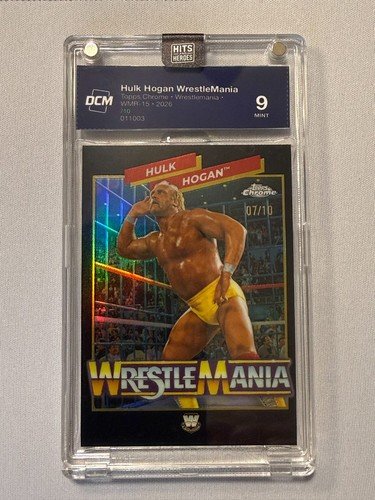
An important distinction is that DCM does not physically encapsulate cards. Collectors supply their own protective holders and print and apply the DCM labels themselves. Each grade receives a unique certificate number that can be checked through DCM’s online verification system.
How Does DCM Grading Work?
The actual grading process is relatively straightforward, although the technology behind it is considerably more involved.
Step 1: Photograph the card
The collector takes photographs of both sides of the trading card and uploads them through DCM’s website or mobile application.
Image quality is particularly important. The photographs need to show all four corners, the edges, and the card’s surface. Glare, reflections, shadows, poor focus, and camera angles can interfere with the evaluation.
DCM provides image-quality guidance and a confidence assessment to help collectors understand how reliably the submitted photographs represent the card.
Step 2: DCM Optic analyzes the card
The software evaluates four familiar grading categories:
- Centering
- Corners
- Edges
- Surface
These are the same broad categories that collectors encounter when submitting cards to established grading companies.
DCM’s approach involves three independent grading passes. It uses the median result of those passes rather than simply averaging them. The intention is to reduce the influence of an unusually high or low assessment from any single pass.
The system also performs magnified inspections of individual regions. Corners, edges, and surface areas are examined in separate image crops, allowing the software to identify defects that might be difficult to recognize when looking at the entire card.
This additional inspection can lower an individual category’s score when a defect is identified.
Step 3: Receive the grade and condition report
Once the analysis is complete, the collector receives a numerical grade, individual category scores, and supporting condition information.
Rather than providing only a number, DCM attempts to explain the reasoning behind its assessment.
This is an important feature. A collector can examine the reported condition issues and understand why a card received an 8 instead of a 9, for example.
DCM also assigns an image-confidence rating. This is particularly useful because a grade based on a sharp, well-lit photograph should carry more confidence than one based on an image with glare or limited visibility.
Step 4: Create a label and protect the card
After grading, collectors can create a customized label and print it for use with a protective card holder.
The label includes the card’s grading information and certificate identification. A QR code allows someone examining the card to access its digital grading record.
Collectors can use different protective formats, including magnetic one-touch holders and other suitable cases.
The important distinction is that the physical holder is not manufactured, sealed, or authenticated by DCM. The company provides the grading record and label, while the collector supplies and assembles the physical presentation.
This is a fundamental departure from the traditional grading model.
Understanding the DCM Grading Scale
DCM uses a whole-number grading scale from 1 to 10. Unlike some established grading companies, its published system does not use half grades or decimal grades.
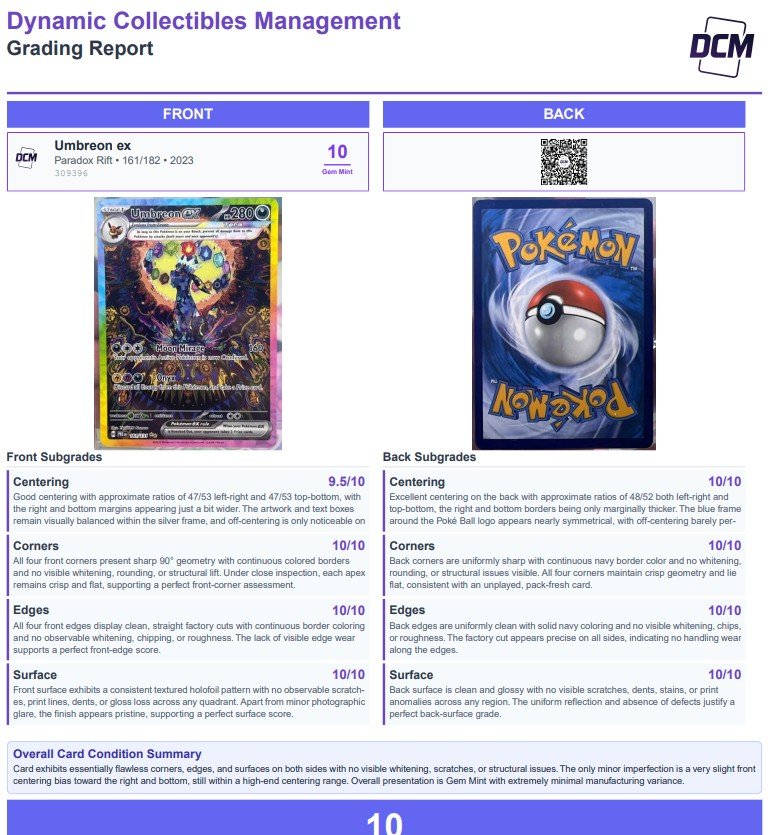
The four grading categories are evaluated independently on the front and back of the card. The lower score for each category becomes that category’s final subgrade. The overall grade is then determined by the lowest of the four subgrades.
For example, consider a card with the following assessment:
| Category | Grade |
|---|---|
| Centering | 10 |
| Corners | 9 |
| Edges | 10 |
| Surface | 8 |
| Final DCM grade | 8 |
Even though three categories are exceptionally strong, the surface condition limits the overall grade.
This weakest-category approach is particularly important because it prevents a card with a significant flaw in one area from receiving an artificially high overall grade simply because the other categories are excellent.
The published grading standard also provides detailed descriptions of the individual grades.
| Grade | Description |
|---|---|
| 10 | Gem Mint |
| 9 | Mint |
| 8 | Near Mint-Mint |
| 7 | Near Mint |
| 6 | Excellent-Mint |
| 5 | Excellent |
| 4 | Very Good-Excellent |
| 3 | Very Good |
| 2 | Good |
| 1 | Poor |
DCM has also published its grading criteria, allowing collectors to examine the rules behind its assessments rather than relying entirely on an unexplained numerical result.
This transparency could become one of its more important selling points. Collectors have long debated the consistency of professional grading, particularly when two different graders assign different scores to apparently similar cards. A published, repeatable methodology offers an alternative approach to that problem.
The Advantages of DCM Grading
There are several reasons why DCM could attract attention from collectors.

1. Speed
Traditional grading can involve submission preparation, shipping, receiving, authentication, grading, encapsulation, and return shipping. Depending on the company and service level, the process can take weeks or months.
DCM dramatically reduces that waiting period. A collector can receive an assessment in approximately one minute.
For someone evaluating a recently opened Pokémon card or a newly acquired sports card, this is a substantial convenience.
2. Cost
Professional grading can become expensive, particularly when a collector wants to evaluate a large number of cards.
DCM uses a credit-based pricing system, with individual grading credits and larger packages or membership options. Its pricing is designed to make repeated evaluations more economical than traditional mail-away grading.
This could be especially appealing to collectors who want to assess hundreds of cards without spending substantial amounts on conventional grading submissions. Current prices should be checked directly with the company because packages and membership offers can change.
3. No shipping risk
Anyone who has submitted valuable cards for grading understands the concerns associated with shipping.
Cards can be lost, damaged, delayed, or mishandled during transportation. Insurance adds another expense and does not necessarily eliminate the inconvenience of dealing with a shipping problem.
With DCM, the card remains in the collector’s possession throughout the process.
4. Collection management
DCM also offers collection-management and portfolio features. Collectors can organize graded cards, review their assessments, and access market-value information.
This could prove useful for people who own large collections and want a consistent method of documenting condition.
5. Transparency
The availability of individual condition reports and publicly verifiable grading records is another positive feature.
Instead of simply displaying a number on a label, DCM provides a way for another collector to examine the photographs and grading information associated with that particular card.
These features potentially make DCM useful even for collectors who have no intention of selling their cards.
The Limitations: What Collectors Need to Understand about DCM Grading
Despite its advantages, DCM faces some significant challenges. Some are technological, while others involve the traditions and economics of the collecting industry.
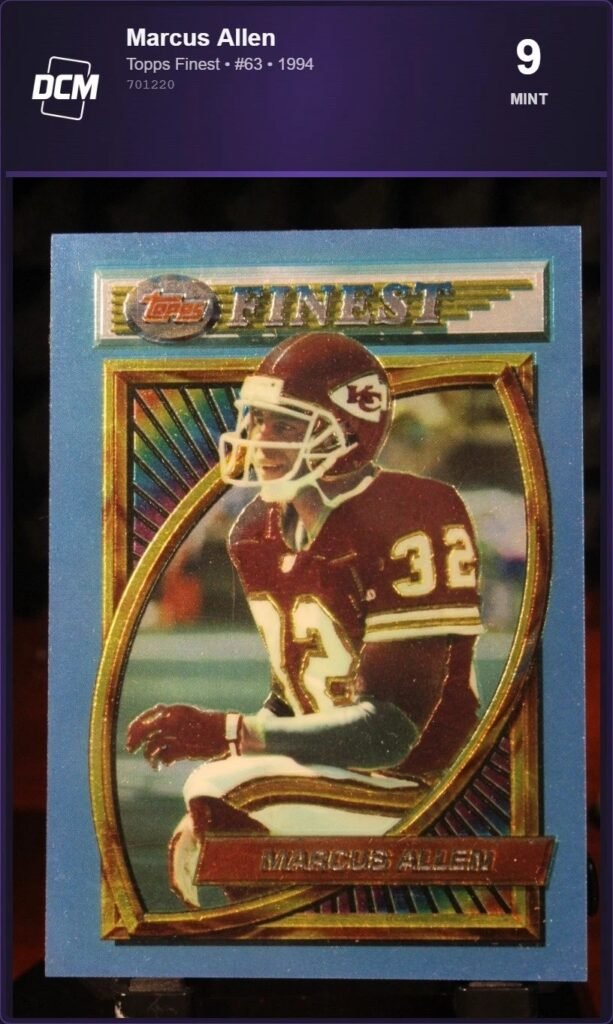
1. Photographs cannot reveal everything
This is probably the most obvious limitation of photograph-based grading.
A camera can capture visible scratches, whitening, corner damage, and centering problems. However, some defects are difficult to detect without physically handling a card and examining it under different lighting conditions.
Subtle indentations, surface impressions, certain alterations, and structural problems may not be apparent in ordinary photographs.
Holographic, chrome, and foil cards introduce additional complications because reflections can conceal imperfections or create misleading visual artifacts.
DCM acknowledges that its assessments depend on the quality and visibility of the submitted photographs. Its confidence rating is therefore an important part of interpreting the result.
2. DCM does not authenticate cards
This distinction deserves particular attention.
DCM evaluates visible card condition. It does not independently establish whether a card is genuine, counterfeit, altered, restored, or otherwise tampered with.
Consequently, a DCM Gem Mint 10 should not be interpreted as proof that a card is authentic.
For expensive vintage sports cards, rare Pokémon cards, and other high-value collectibles, authentication remains an essential consideration.
3. The physical holder is not tamper-evident
Traditional grading companies encapsulate cards in holders designed to discourage unauthorized removal or substitution.
DCM takes a different approach. Collectors supply their own holders and apply their own labels.
The digital certificate is linked to the photographs taken during grading, but DCM cannot guarantee that the card currently inside a particular holder is the same card originally photographed.
This means buyers should scan the QR code and compare the physical card against the original images before purchasing. It is an important distinction between a digitally verified condition assessment and a professionally encapsulated collectible.
Affiliate Disclosure: This post contains affiliate links. T. C. Trading Cards earns a small commission on qualifying purchases as an Amazon Associate at no additional cost to you.
How Will the Collecting Industry Receive DCM Grading?
This is where things become particularly interesting.
The trading card industry is not necessarily resistant to technological innovation. Collectors have embraced online marketplaces, digital collection-management applications, population reports, price-tracking services, and increasingly sophisticated authentication technologies.
However, professional grading occupies a special position in the hobby.
A PSA 10, for example, is not simply a statement about the physical condition of a card. It is also a recognizable designation supported by decades of company history, marketplace familiarity, population data, and established buyer confidence.
The value of a professionally graded card is therefore influenced by two separate considerations:
- The actual condition of the card.
- The reputation and market acceptance of the company assigning the grade.
DCM must establish both.
I expect its reception to develop in several stages.
1. Initial acceptance of DCM Grading among casual collectors
The first group likely to embrace DCM will be collectors who are more interested in evaluating and organizing their collections than maximizing resale value.
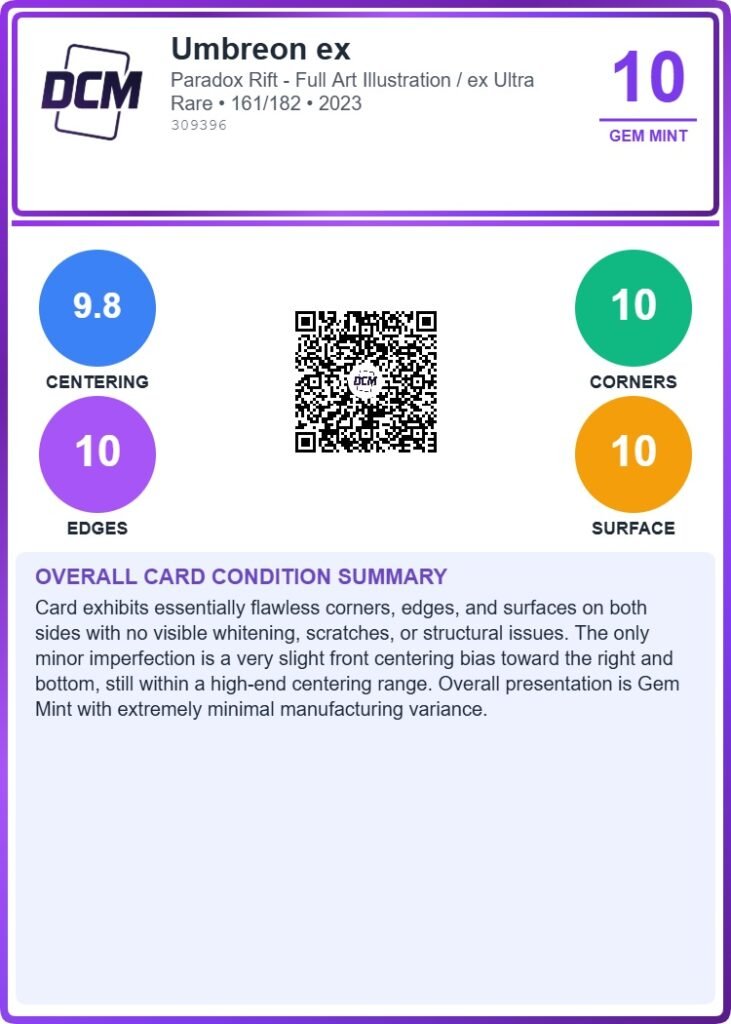
Imagine someone with 500 Pokémon cards accumulated over several years. Sending every potentially valuable card to PSA or another professional grading company would be financially impractical.
DCM provides a relatively inexpensive way to assess those cards and identify candidates that might justify professional grading.
This is an appealing proposition.
Collectors could use the software as an initial screening tool, separating cards that appear to have excellent condition from those that clearly do not warrant an expensive submission.
In this capacity, DCM does not necessarily need to replace established grading companies. It simply needs to provide a useful service that collectors find worthwhile.
2. Skepticism from established grading enthusiasts
The reaction from serious collectors and high-end investors will probably be more cautious.
Collectors who routinely purchase expensive PSA, BGS, CGC, or SGC graded cards are accustomed to physical authentication, professional inspection, and tamper-evident encapsulation.
A self-assembled holder with a digitally generated grade does not provide exactly the same assurances.
There will also be questions about the accuracy and consistency of artificial intelligence grading.
How does the software handle extremely subtle surface imperfections? Can it consistently identify factory defects? Does it evaluate vintage cardboard using the same expectations as modern chrome cards?
These are legitimate questions.
DCM will need to demonstrate its accuracy through independent comparisons, repeated testing, and transparent documentation.
Its published grading standard is a positive beginning, but the collecting community will ultimately judge the technology by its results.
3. The secondary market will determine its success
The most important test will be whether buyers are willing to pay a premium for DCM-graded cards.
A grading company can produce excellent reports, attractive labels, and sophisticated technology. None of those features guarantees that collectors will pay more for its graded cards.
The secondary market is driven by buyer confidence.
If collectors believe that a DCM 10 reliably represents an exceptionally conditioned card, the service could establish a meaningful position in the marketplace.
However, if buyers consistently prefer raw cards or established grading-company slabs, DCM grades may remain primarily useful for personal collection management.
DCM has begun addressing this issue through its InstaList selling functionality and published sales comparisons. Its website reports premiums for certain DCM-graded cards sold through that channel, although these are company-reported results rather than independent evidence of broad market acceptance.
The more important long-term measurement will be sustained transaction volume and repeatable price premiums across different card categories.
4. Competition could eventually force traditional graders to adapt
Perhaps the most interesting possibility is that DCM’s approach could influence the established grading companies.
Traditional grading involves considerable labor, specialized facilities, physical handling, shipping logistics, and administrative expenses.
Artificial intelligence could potentially reduce some of these costs while providing more detailed documentation of card condition.
Even if DCM never becomes a dominant grading company, it could encourage existing companies to incorporate automated image analysis into their own grading processes.
That would be a significant development.
I would not be surprised if the industry eventually moves toward hybrid grading systems in which artificial intelligence performs preliminary evaluations while human graders make final decisions on valuable or difficult submissions.
Such a system could improve consistency without eliminating the advantages of physical examination.
DCM Grading Versus Traditional Grading Companies
The following comparison illustrates the fundamental differences between DCM and established mail-in grading services.
| Feature | DCM | Traditional grading |
|---|---|---|
| Submission method | Photographs | Physical card |
| Turnaround | About one minute | Usually longer |
| Physical inspection | No | Yes |
| Authentication | No | Depends on service |
| Encapsulation | Collector supplied | Company supplied |
| Grading report | Digital | Varies by company |
| Verification | Digital certificate | Company certification |
| Shipping required | No | Generally yes |
| Market recognition | Developing | Established |
Neither approach is necessarily appropriate for every collector.
For personal collection management, preliminary evaluations, and inexpensive condition assessments, DCM offers some compelling advantages.
For expensive cards intended for resale, authentication and established marketplace recognition remain important considerations.
My Prediction: DCM Will Find a Place in the Hobby, but It Has Something to Prove
I believe DCM Grading represents a worthwhile experiment in the evolution of trading card collecting.
Its greatest strength is not necessarily its ability to compete directly with PSA or Beckett. It is the possibility of making detailed card-condition assessments available to collectors who would otherwise never consider professional grading.
That is a substantial potential market.
There are millions of cards in personal collections that are not valuable enough to justify traditional grading fees. Many collectors would nevertheless enjoy knowing whether a particular card is in excellent, near-mint, or heavily played condition.
DCM could serve that audience.
I also think its collection-management capabilities could become increasingly important. A platform that combines card identification, condition assessment, grading records, market information, and sales tools offers considerably more functionality than a simple numerical grading service.
Nevertheless, I would be cautious about predicting that DCM grades will command the same premiums as PSA, BGS, or CGC grades anytime soon.
That kind of marketplace recognition takes time. It requires a substantial population of graded cards, widespread collector awareness, reliable verification, and a consistent history of completed sales.
Most importantly, DCM must demonstrate that its grading technology produces dependable results across different card types, ages, finishes, and manufacturing variations.
The company has published its grading standards and limitations, which is encouraging. The next step is establishing confidence through independent scrutiny and marketplace performance.
My expectation is that DCM will initially become more popular as a pre-grading and collection-management tool than as a direct replacement for traditional grading.
If the technology proves reliable and the secondary market begins recognizing its grades, however, that role could expand considerably.
Final Thoughts
DCM Grading introduces an interesting alternative to the traditional trading card grading model. By combining artificial intelligence, photographic analysis, digital certificates, and customizable labels, it removes several of the barriers that have historically discouraged collectors from grading their cards.
It is faster, more convenient, and potentially much less expensive than conventional grading.
But convenience and accuracy are not the same thing as marketplace acceptance.
The collecting industry has spent decades building confidence in established grading companies. DCM must earn that same confidence through transparency, consistency, and demonstrable results.
I suspect the most successful application of DCM will initially be among collectors who want to understand the condition of their cards without necessarily preparing them for professional resale.
Whether it eventually becomes a recognized competitor in the professional grading market remains to be seen.
One thing is certain: artificial intelligence is beginning to change how collectors evaluate their cards, and DCM Grading is an interesting company to watch as that transformation develops.
Editorial note: This article reflects DCM’s published service description and grading standard as of November 2026. The assessment of its likely industry reception is editorial analysis, not an established market consensus.