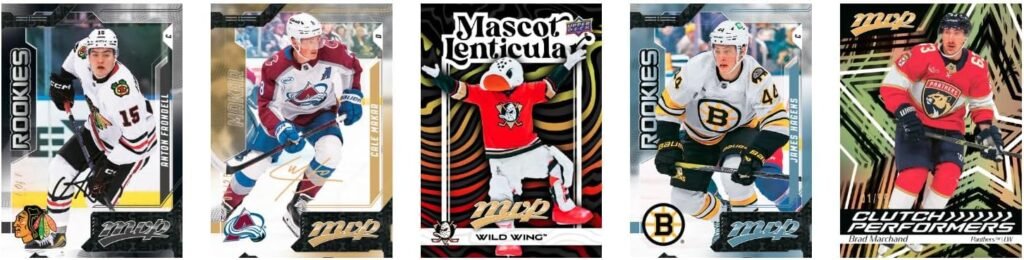
2026–27 Upper Deck MVP Hockey
The 2026–27 Upper Deck MVP Hockey release has arrived at an interesting moment for the hockey-card market. Released August 5, 2026, the product offers collectors a familiar low-to-mid-tier entry point, but the checklist is packed with young stars, established superstars and, most importantly, several players whose long-term hobby profiles could change dramatically over the next few seasons.
Disclaimer:
The information provided in this post is for informational and educational purposes only. It does not constitute financial advice, investment guidance, or an endorsement of any company, product, or service. The trading card market is inherently speculative and subject to rapid changes in value and demand.
Collectors and investors should conduct their own independent research, verify all claims made by third party sellers, and assess risks before making any purchasing or investment decisions. Past performance, resale value, or popularity of any product or company is not a guarantee of future results.
T. C, Trading Cards, McRae Enterprises L.L.C. or its authors assumes no responsibility or liability for any losses, damages, or outcomes resulting from the use of this information or participation in any trading card purchases, repacks, or investment activities.
250-card base MVP set
2026-27 Upper Deck MVP Checklist
The 250-card base configuration consists of 200 regular cards and 50 SP/Rookie cards, with the latter appearing much less frequently. Hobby boxes contain 20 packs of eight cards, while the product also includes retail and blaster configurations.
For collectors, however, the most important question isn’t simply whether the set is attractive.
It is: which 2026–27 MVP cards could actually appreciate in value?
The answer probably won’t be the cards that are most expensive on release day. As with many modern hockey products, the biggest opportunities may come from identifying players whose careers are still in the early stages.

The Macklin Celebrini Factor
If there is one player who immediately stands out on the checklist, it is Macklin Celebrini.
The San Jose Sharks center appears throughout the product, including a Base SP, Colors & Contours card numbered to 250, Gotta Have Hart, The Slot and a Paired Up card with Will Smith.
Celebrini’s importance to the MVP market goes beyond the number of cards featuring him. He represents the type of player around whom collectors can build an entire modern rookie-era portfolio.
His 2026–27 MVP cards should therefore be divided into tiers.
The regular base card is unlikely to become a major investment piece simply because modern production makes plentiful base cards difficult to sustain significant premiums. The more interesting targets are the SP, numbered Colors & Contours and short-printed inserts.
Colors & Contours is particularly intriguing. The Celebrini card is numbered to 250, with the parallel structure continuing to Green /20, Purple /3 and printing plates.
If Celebrini eventually becomes an MVP-caliber player—or a Stanley Cup centerpiece—those low-numbered cards could look remarkably inexpensive in retrospect.
Michael Misa Could Be the MVP Sleeper
The player I would watch most closely outside the obvious names is Michael Misa.
Misa appears on the San Jose checklist alongside Celebrini, and his rookie presence gives collectors another potential long-term investment candidate.
This is precisely where MVP can become interesting.
Collectors sometimes overlook inexpensive products because they are focused on flagship Young Guns, premium autographs and high-end memorabilia cards. But a player who develops into a major NHL star can eventually create demand across his entire early-card catalog.
Misa’s MVP cards therefore represent a high-risk, high-upside proposition.
There is no guarantee that his career will follow the trajectory collectors currently hope for. But if he becomes a perennial All-Star, the inexpensive rookie-era MVP cards could experience substantial percentage gains simply because the entry point is low.
His sticker rookie, MVP-34, is another card worth watching, although I would rank the more traditional rookie and scarce parallels above the sticker for long-term investment purposes.
Mathew Schaefer and the Rookie Question
Another fascinating name is Matthew Schaefer of the New York Islanders.
Schaefer appears in the base lineup and on the Paired Up checklist, as well as receiving a dedicated sticker.
The important distinction for collectors is that MVP is not necessarily going to be the flagship rookie card that ultimately defines Schaefer’s hobby market. Future Upper Deck flagship releases and their Young Guns cards could command considerably more attention.
That doesn’t make MVP irrelevant.
In fact, it could make the product more interesting for collectors who want to acquire a promising player before the hobby settles on his definitive rookie cards.
If Schaefer develops into a franchise defenseman, his numbered MVP parallels could become attractive alternatives to much more expensive flagship rookies.
Porter Martone Is Another Name to Remember
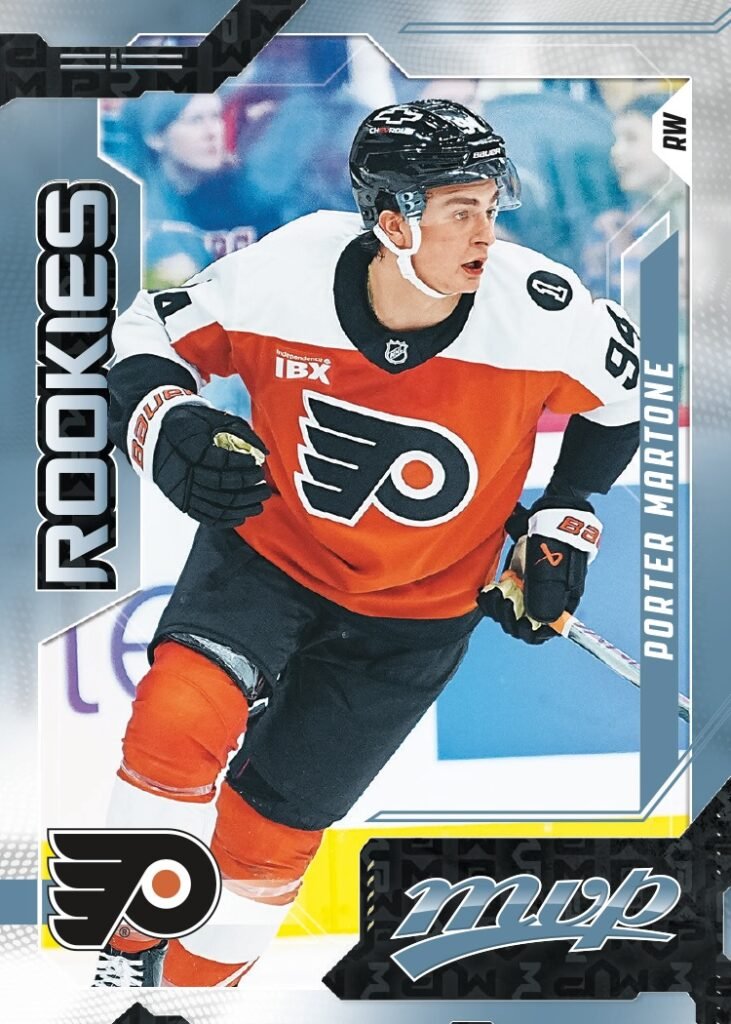
Philadelphia’s Porter Martone is one of the rookies that could generate considerable interest.
The checklist includes his Base Rookie and Colors & Contours Rookie /250, giving collectors an immediate numbered version to chase.
The key here is patience.
Martone does not need to become a superstar immediately for his cards to appreciate. A strong rookie campaign, increased ice time, playoff exposure or an appearance on a major award ballot could produce temporary spikes in demand.
That makes cards such as Colors & Contours /250 potentially attractive speculative purchases.
But collectors should avoid paying inflated prices simply because a card is a rookie. Scarcity plus player performance, rather than rookie status alone, is what ultimately creates sustainable value.
Don’t Ignore Connor Bedard
It is easy to overlook established stars when discussing a rookie-heavy release, but Connor Bedard may actually provide some of the safer long-term targets.
The 2026–27 checklist includes Bedard in Gotta Have Hart, Paired Up with Frank Nazar, The Slot and the sticker set.
The Paired-Up card is especially interesting because it combines two Chicago young stars.
Bedard’s biggest advantage is simple: collectors already know who he is.
Unlike a prospect, his market doesn’t depend entirely on projection. If he continues progressing toward superstardom, his cards should benefit from the broader growth of the hockey-card market.
The danger is valuation.
Bedard cards already command substantial collector attention, meaning buyers may be paying for a large amount of future success. I would therefore favor scarce Bedard inserts and numbered parallels over ordinary base cards.
The McDavid–Draisaitl Combination
At the opposite end of the career spectrum are Connor McDavid and Leon Draisaitl.
Their Paired Up card is one of the most obvious collector targets in the product. The standard version is relatively accessible, while the Gold parallel is numbered to 299.
There is an important investment lesson here.
A card doesn’t necessarily need to feature a rookie to become desirable. Iconic player combinations can develop lasting collector demand, particularly when the players eventually become associated with a specific era of NHL history.
If McDavid and Draisaitl ultimately enter the conversation among the greatest player combinations of their generation, early cards depicting them together could acquire considerable nostalgia value.
This is probably a long-term hold rather than a quick flip.
The Real Chase Cards: Low-Numbered Parallels
The most compelling investment argument for 2026–27 MVP isn’t actually the base set.
It is the parallel structure.
Colors & Contours includes Gold /250, Green /20 and Purple /3 versions, plus printing plates.
The hobby’s familiar pattern should apply: the lower the print run, the more sensitive the card becomes to player performance.
A Celebrini /3 is potentially a very different asset from a Celebrini /250. A Misa /20 could become considerably more interesting if he emerges as a star. A future superstar’s 1/1 printing plate could become a genuinely scarce piece of that player’s early NHL cardboard history.
There are also Super Script cards numbered to 25 and Black Super Script 1-of-1s in the product configuration.
For serious collectors, these are the cards to monitor.
The Wild Card: The No. 1 Pick Redemption
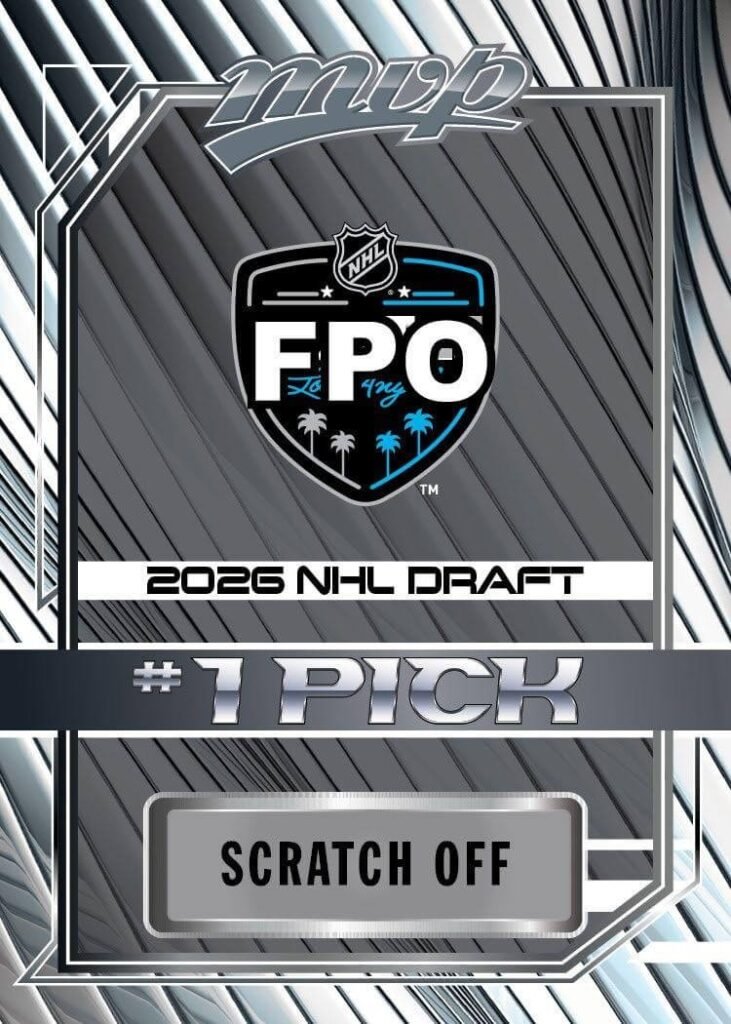
Perhaps the most intriguing card in the entire product is the 2026 NHL Draft No. 1 Pick SP Redemption.
The card is extraordinarily difficult to pull: the stated odds are 1:1,250 in hobby/e-Pack and 1:12,500 in retail/blaster, with a Gold parallel also available.
Because the card ultimately represents the No. 1 pick from the 2026 draft, its value will be heavily influenced by what that player becomes.
That creates an unusual investment profile.
Collectors are essentially purchasing a piece of uncertainty.
If the player becomes a franchise superstar, the redemption could become one of the most memorable cards in the product. If he becomes merely a good NHL player, the enormous scarcity could still preserve interest, but perhaps not at the levels early speculation suggests.
Early collector reports are already showing substantial excitement around the card, illustrating how quickly scarcity can create a speculative market immediately after release.
What Could Happen to the Overall MVP Market?
The 2026–27 MVP release could reinforce an important trend in the hockey-card market: collectors are increasingly separating player value from product prestige.
Upper Deck MVP is not positioned like The Cup or a premium flagship product. Its strength is accessibility.
That means thousands of collectors can participate without committing hundreds or thousands of dollars to a box.
The downside is supply. Large numbers of inexpensive cards can suppress the value of ordinary base cards and common inserts.
The upside is that low entry prices make MVP cards excellent speculation vehicles.
If Celebrini, Misa, Schaefer, Martone, Bedard or another young player becomes a major NHL star, collectors may start looking backward for affordable early cards. At that point, the scarce MVP parallels could move considerably faster than the ordinary base cards.
Affiliate Disclosure: This post contains affiliate links. T. C. Trading Cards earns a small commission on qualifying purchases as an Amazon Associate at no additional cost to you.
Final Investment Outlook
My early ranking for cards with the strongest potential would be:
1. Macklin Celebrini low-numbered parallels — the best combination of established hobby demand and long-term upside.
2. Michael Misa rookie parallels — potentially the highest-risk/highest-reward play.
3. Matthew Schaefer rookie parallels — particularly attractive if his NHL trajectory develops quickly.
4. Porter Martone Colors & Contours /250 — an inexpensive way to speculate on a promising rookie.
5. Connor Bedard scarce inserts and parallels — probably lower upside percentage-wise, but considerably less dependent on projection.
6. McDavid/Draisaitl Paired Up Gold /299 — a long-term collector play with strong historical potential.
7. 2026 No. 1 Pick Redemption — the ultimate lottery-ticket card.
The biggest mistake would be assuming that every rookie in the product will appreciate simply because it says “RC” on the card.
The better strategy is to identify scarcity, player trajectory and collector demand at the same time.
That is what makes the 2026–27 Upper Deck MVP Hockey set worth watching. Most of its cards will remain inexpensive. A handful, however, could become unexpectedly important pieces of the hockey-card market if today’s promising players become tomorrow’s superstars.